An English version is provided below. I have used AI assistance for the translation, but I have checked the text myself.
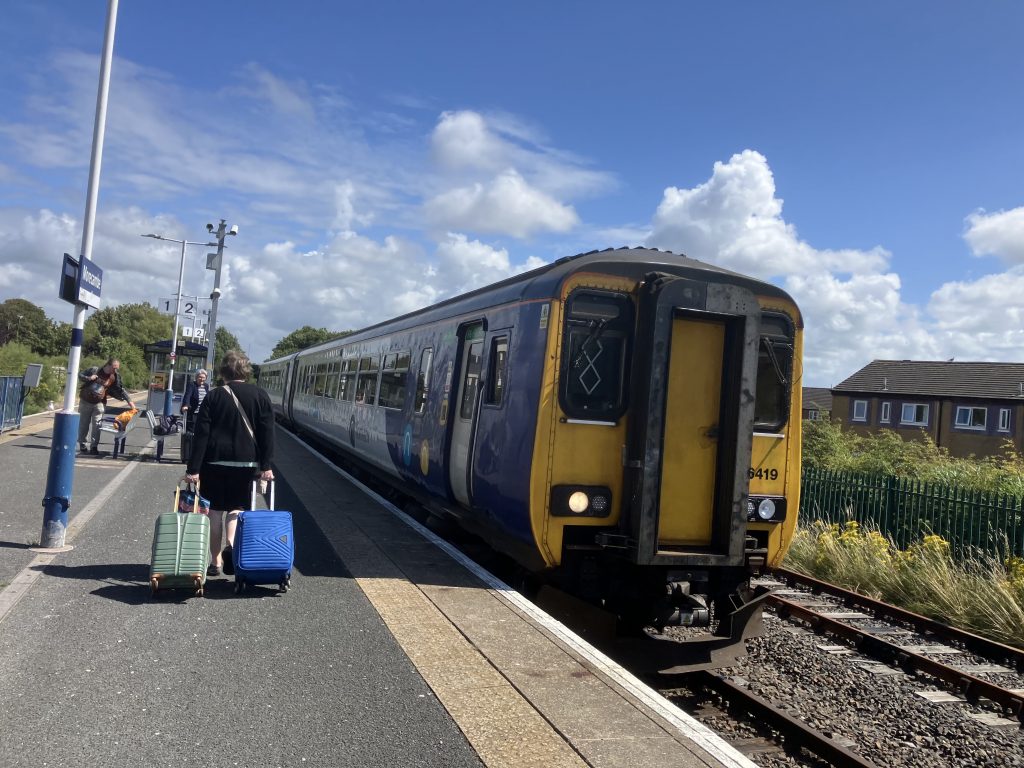
いま、マンチェスター空港へ向かう列車の中で、これを書いている。
8月11日からモントリオールで開催されるInternational Network of Philosophers of Education(INPE)の大会に参加するためである。
今回の大会では、ヴィトゲンシュタイン哲学と教育における他者性をめぐるラウンドテーブルで発表することになっている。
公式の日程は8月11日から14日まで。テーマは “Initiating New Conversations Across a Divided World”。
分断された世界で、新しい対話を始めるという。
もっとも、そのような大仰なテーマについて考える以前に、列車は遅れている。
ランカスターからマンチェスター空港までは、順調ならそれほど大変な旅ではない。
ところが今日は、大型の荷物を置くスペースがなく、座席を予約してたにも関わらず座るまでに30分以上かかり、その後も遅延している。こちらに来て遅延を経験するのももう4度目だ。
そんな車内で、少し嬉しいことがあった。
フランス語しか話せない、めちゃくちゃオシャレな長身の紳士が、どうやら列車を間違えてしまったらしい。
困っている彼を前に、近くにいた三人ほどが自然に集まり、乗り換えを調べ、身振りを交えながら説明した。
私もその輪に加わった。
無事に伝わったらしい。
それだけのことなのだが、私はとても嬉しかった。
混雑していて遅延もしている、フラストレーションの溜まる車内。
その中でも、人の温かさに触れられる。通路で待っているときにも、ちょっとしたコミュニケーションを周りの人ととり、気遣いを示す。
英国に来て四カ月余り。これまで私は、ずっと助けてもらう側だった。
役所でわからない。病院でわからない。大学や子供の学校でわからない。電車でわからない。 こちらでは、大人として当然身につけていたはずの能力が、しばしば役に立たなくなる。
それが今日、少しだけ、助ける側に回れた気がした。
私の英語が急に上達したわけではない。相変わらず、言いたいことの半分も言えないことがある。
ただ、それを以前ほど重大なことだと思わなくなった。
これは、この四カ月で起きた小さくない変化かもしれない。
7月、マンチェスター大学での客員研究員期間を終え、ランカスター大学での新しい研究生活が始まった。
ちょうどその頃、ブリストルでInternational Conference of Autoethnographyに参加した。
2026年の大会テーマは「Connections」。会場はクリフトンのEngineers Houseで、オンラインと対面を組み合わせた大会だった。 ブリストルの街を歩けば、壁に描かれた絵が嫌でも目に入る。
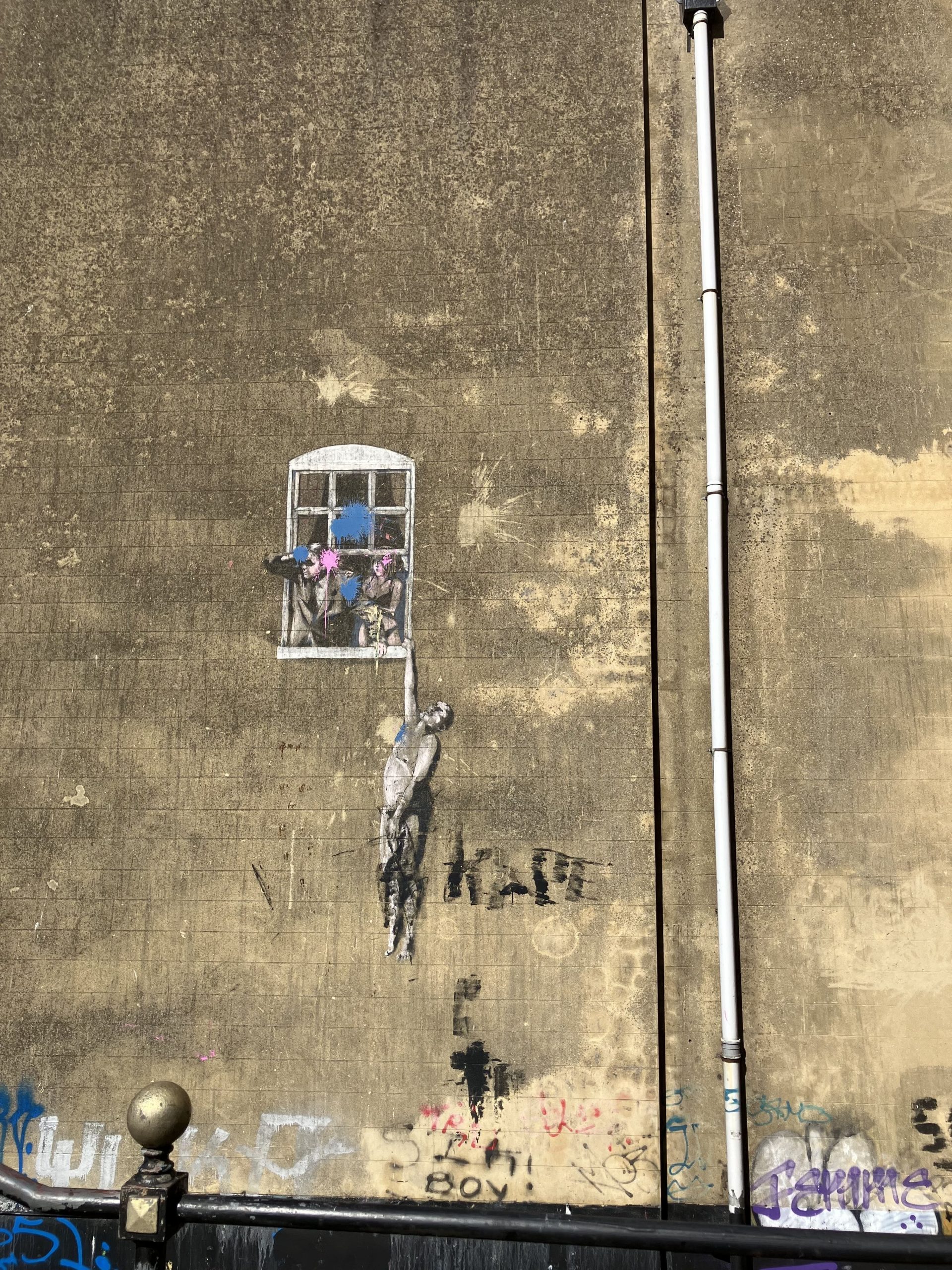
Banksyが生まれ育った街として知られ、現在も初期作品を含むストリートアートが街のあちこちに残っている。
壁に描かれたものは、美術館の作品とは少し違う。 誰かが描き、誰かが上から描き、雨にさらされ、消され、ときには保存される。作品は「完成」したあとも、街の側から勝手に続きを書き加えられていく。
考えてみれば、オートエスノグラフィーという研究方法にも、どこか似たところがある。 学会では、私自身の幼少期の絵をスクリーンに映しながら話した。

普段の研究発表では、研究者である私はなるべく後景に退く。
資料があり、方法があり、分析があり、そこから何が言えるかを論じる。
しかし、自分自身の経験を研究の素材にすると、そうはいかない。
なぜその問いを持ったのか。なぜその出来事だけを覚えているのか。
研究対象を眺めている自分自身もまた、研究の外には立てない。
ブリストルからランカスターへ戻ってから、そのことを考えながら、Journal of Autoethnographyへの投稿を目指す原稿を必死に書いた。
そこから、妙な勢いがついた。
『世界新教育運動辞典』の芦田恵之助の項目を書き、『長田新の中国講演とその研究』の校正を進め、教員養成課程で使用する道徳教育のテキストの一章を書いた。科研費による研究成果として刊行する書籍の一章も書き、「ゴフマン論文集」の担当章にも取り組んだ。
もちろん、すべてを7月に執筆したわけではない。何年も前から考えていたもの、共同研究として進めてきたもの、締切が静かにこちらへ近づいてきたものが、たまたま同じ時期に机の上へ集まっただけである。
それでも、それぞれの草稿がひとまず形になっていくのを見ながら、ようやく「サバティカルが始まった」と思った。
英国へ来て、もう四カ月も経ってからである。
サバティカルに入る前、私はもう少し違う生活を想像していた。
静かな研究室があって、本を読み、考え、文章を書く。授業も会議も少ないのだから、当然、研究は進むはずである。 ところが実際に英国へ来てみれば、最初に必要だったのは研究ではなかった(毎回言ってる気がする)。
家を探し、銀行や行政の手続きをし、子どもの学校や保育のことを調べ、病院に行き、壊れたものを直し、知らない制度の中で家族四人の生活を成立させる。
研究するために英国へ来たのに、研究をするための生活をつくることに、ずいぶん時間がかかった。
けれども最近、それでよかったのではないかと思う。
研究は、生活を取り除いたところに残る純粋な時間の中で行われるわけではない。
身体があり、家族があり、食事があり、眠気があり、電車の遅延がある。
その全部を抱えた人間が研究している。
だから最近、毎日「股割り」をしている。
-1024x683.png)
英国で始めた習慣の一つで、床に脚を広げ、動画を見ながら身体を伸ばす。
最初は笑ってしまうほど曲がらなかった。今も、写真だけ見れば「これのどこが股割りなのか」という疑問はもっともである。
けれど、毎日やっていると、少しずつ身体が変わる。
昨日と今日では、ほとんど違わない。 一週間でも、よくわからない。
それでも一カ月前の写真と比べると、確かに違う。
最近、研究も英語もこれくらいでいいのではないかと思うようになった。
以前の私は、学会へ行くとき、かなりの確率で満身創痍だった。 日常業務を終えてから発表準備を始め、「休日」、つまり大学の仕事が入っていない日や時間に研究を進める。 締切前には徹夜もする。それでも足りなければ移動中にスライドを直し、ホテルで読み上げ原稿を書き、発表直前まで修正する。
「完成させてから人前に出す」という感覚が強かったのだと思う。
もちろん、準備することは大切である。未完成であることを、準備不足の言い訳にしてはいけない。
私は気が弱いので、準備不足だと寝られなくなったり、トイレにこもって出られなくなったりと、集中力がなくなって本当に悪循環になる。
しかし、いつからか、「完成」のために自分を削り続けることを、研究への誠実さだとは思えなくなった。
昨年、大阪にユーリア・エンゲストローム先生をお迎えした際のことを、たびたび思い出す。
そのとき印象に残ったのは、研究の「途中」を人前に出すことについての話だった。
研究者がまだ形になりきっていない仕事を差し出す。
それを周囲の人が受け止め、そこに本人も気づいていなかった価値を見つけ、次へ進む力を与える。
研究発表とは、完成品を検査に出すことだけではない。
途中にあるものを、途中にあるものとして共同体に差し出すことでもある。
そう考えるようになってから、学会へ向かう気持ちが少し変わった。
友人が、こんな言葉をかけてくれた。
「批判は挑戦者の名誉だ」
たしかに、批判されたくなければ、何も差し出さなければよい。
論文を書かなければ査読で落ちない。学会で発表しなければ質問にも困らない。新しい研究を始めなければ失敗もしない。
けれど、それでは研究をしていることにはならない。
重要なのは、おそらく、傷つかないほど強くなることではない。 完成していない自分のまま、それでも何かを差し出せることなのだと思う。
これは研究だけの話でもないのかもしれない。 語学が堪能になってから人を助けるのではない。
立派な父親になってから子どもを育てるのでもない。
すべてを理解してから異文化の中で暮らすのでもない。
私たちはたいてい、途中のまま、何かを始める。 列車はまだ遅れている。
けれど、以前ほど焦ってはいない。
この先、マンチェスターから飛行機に乗り、アムステルダムを経由して、モントリオールへ向かう。
そこで私は、また完成していない研究を話すことになる。
今日ここまで来られたことも、決して私一人の力ではない。 研究の機会を与えてくれる大学があり、送り出してくれる家族がいる。発表しようと誘ってくださる共同研究者がいて、仕事を引き受けてくれている同僚がいる。
そして今日のように、知らない誰かと一緒になって、知らない誰かを助けることもある。
そうした無数の支えの上を、私は移動している。
窓の外を、イングランド北西部の景色がゆっくり後ろへ流れていく。
四カ月前、この国に来た私は、できないことばかり数えていたように思う。
英語も、研究も、生活も、身体も、まだ十分ではない。 それは今も、ほとんど変わっていない。 ただ最近、その「まだ」を、それほど悪い言葉だと思わなくなった。
Notes from My Stay in the UK, No. 7
Moving On While Still “In Progress”
I am writing this now on a train bound for Manchester Airport.
I am on my way to attend the conference of the International Network of Philosophers of Education (INPE), which will be held in Montreal from 11 August.
At the conference, I will be presenting as part of a roundtable on Wittgenstein’s philosophy and otherness in education. The conference runs from 11 to 14 August under the theme, “Initiating New Conversations Across a Divided World”: beginning new conversations in a world marked by division.
Before I can think too seriously about such a grand theme, however, the train is delayed.
The journey from Lancaster to Manchester Airport is not especially difficult when everything runs smoothly.
Today, though, there was nowhere to put my large luggage, and despite having reserved a seat, it took me more than thirty minutes before I was finally able to sit down. The train has remained delayed ever since. This is already the fourth time I have experienced a significant delay since coming to the UK.
Still, something happened in the carriage that made me unexpectedly happy.
A tall, remarkably stylish gentleman, who seemed to speak only French, had apparently boarded the wrong train.
Seeing that he was in trouble, about three people nearby naturally gathered around him. They checked the connections, explained what he needed to do, and relied on gestures where words failed. I joined them.
It seemed that, in the end, he understood.
That was all. Yet I was genuinely happy.
The train was crowded and delayed, and everyone had good reason to be frustrated. Even so, there was warmth among the passengers. While we were waiting in the aisle, people exchanged small remarks, acknowledged one another, and showed little gestures of consideration.
It has now been more than four months since I arrived in the UK. Until now, I have almost always been the one receiving help.
I do not understand how things work at public offices. I do not understand at the hospital. I do not understand at the university or at my children’s schools. I do not understand on the train.
Here, abilities that I had taken for granted as an adult quite often stop being useful.
Today, for once, I felt that I had moved, if only slightly, to the side of the person offering help.
My English has not suddenly improved. I still often fail to say even half of what I want to say. But I have begun to feel that this matters less than I once thought it did.
That may be one of the more significant changes of these past four months.
In July, my period as an academic visitor at the University of Manchester came to an end, and a new period of research began at Lancaster University.
Around the same time, I attended the International Conference of Autoethnography in Bristol. The theme of the 2026 conference was “Connections.” It was held at Engineers House in Clifton in a hybrid format combining in-person and online participation.
If you walk through Bristol, it is difficult not to notice the images painted on its walls. The city is well known as the place where Banksy was born and raised, and street art, including some of his early work, remains scattered throughout the city.
Things painted on walls are a little different from works displayed in museums.
Someone paints them. Someone else paints over them. They are exposed to rain. They disappear. Sometimes they are preserved. Even after a work has supposedly been “completed,” the city continues to write over it.
Come to think of it, there is something similar about autoethnography as a research method.
At the conference, I spoke while showing drawings I had made as a child on the screen.
In most academic presentations, I try to keep myself, the researcher, somewhere in the background. There are materials, methods, and analyses, and I discuss what can be said on the basis of them.
But once your own experience becomes part of the material for research, that becomes more difficult. Why did I come to have this particular question? Why do I remember this event and not another? The person looking at the object of research cannot simply stand outside the research.
After returning from Bristol to Lancaster, I thought about these questions and worked intensely on a manuscript that I hope eventually to submit to the Journal of Autoethnography.
Somehow, that gave me momentum.
I wrote the entry on Enosuke Ashida for the World Dictionary of the New Education Movement. I continued proofreading the manuscript for Osada Arata’s Lectures in China and Studies of Them. I wrote a chapter for a textbook on moral education used in teacher education. I also wrote a chapter for a book being published as an outcome of a JSPS-funded research project, and worked on my assigned chapter for a planned volume on Goffman.
Of course, I did not write all of these things from scratch in July. Some had been in my mind for years. Some had grown out of collaborative research. Others were simply deadlines that had been quietly approaching until, by chance, they all arrived on my desk at around the same time.
Even so, as I watched each draft take on a provisional shape, I finally began to feel that my sabbatical had truly started.
It had already been four months since I arrived in the UK.
Before beginning my sabbatical, I had imagined a rather different kind of life.
There would be a quiet office. I would read books, think, and write. With fewer classes and meetings, surely research would naturally move forward.
Yet when I actually came to the UK, the first thing I needed to do was not research. I feel as though I write this every time.
I had to find a home, deal with banks and administrative procedures, work out schooling and childcare for the children, go to hospitals, repair broken things, and somehow establish daily life for a family of four inside systems I did not understand.
I had come to Britain in order to do research, yet it took a surprisingly long time simply to build the life that would make research possible.
Recently, however, I have begun to think that perhaps this was not such a bad thing.
Research does not take place in some pure form of time left over after life has been removed. There is a body. There is family. There are meals, sleepiness, and delayed trains. It is a human being carrying all of these things who does research.
That is one reason I have recently been practising matawari every day.
Matawari[股割り] is a stretching exercise in which you sit on the floor with your legs spread wide and work gradually toward a deep forward stretch. It is one of the habits I started after coming to Britain. I spread my legs, follow a video, and stretch.
At first, I was so inflexible that it was almost funny. Even now, if you look only at the photograph, it would be perfectly reasonable to ask, “In what sense does this count as matawari?”
But if I do it every day, my body changes little by little.
There is almost no difference between yesterday and today.
Even after a week, I can hardly tell.
And yet, if I compare a photograph with one taken a month earlier, the difference is unmistakable.
Recently, I have begun to think that research and English may be much the same.
In the past, by the time I arrived at an academic conference, I was often already exhausted.
I would begin preparing the presentation only after finishing my everyday work. I would continue the research on my “days off,” meaning days or hours when there happened to be no university duties.
Before a deadline, I would sometimes stay up all night. If that still was not enough, I would revise slides while travelling, write my script in the hotel, and continue editing until just before the presentation.
I think I had a strong sense that I had to “finish” something before I could show it to other people.
Preparation is, of course, important. Being unfinished should never become an excuse for being unprepared.
I am rather timid by nature, and if I feel underprepared, I stop sleeping properly. Sometimes I end up spending far too long in the toilet and lose my ability to concentrate altogether. It becomes a genuinely vicious circle.
But at some point I stopped believing that continually wearing myself down in the pursuit of “completion” was a sign of scholarly sincerity.
I often think back to something that happened last year, when Professor Yrjö Engeström visited us in Osaka.
What stayed with me was his discussion of the importance of presenting research while it is still “in progress.”
A researcher offers work that has not yet fully taken shape. Other people receive it, notice value that even the researcher may not yet have seen, and help give that work the energy to move forward.
An academic presentation is not only an occasion for sending a finished product out for inspection.
It can also be an act of offering something unfinished to a community precisely as unfinished.
Since I began thinking about presentations this way, the feeling with which I travel to conferences has changed slightly.
A friend once said to me:
“Criticism is an honour earned by those who take on a challenge.”
It is true. If you do not want to be criticised, you can simply choose not to put anything forward.
If you do not write a paper, it cannot be rejected in peer review. If you do not present at a conference, you do not have to struggle with questions. If you do not begin new research, you cannot fail at it.
But that would not really count as doing research.
Perhaps what matters is not becoming so strong that nothing can hurt you.
It is being able to offer something even while you yourself remain unfinished.
Perhaps this is not only about research.
You do not wait until you are fluent in another language before helping someone.
You do not become an admirable father first and only then begin raising children.
You do not understand everything about another culture before beginning to live within it.
Most of the time, we begin things while we are still in progress.
The train is still delayed.
But I am less anxious about it than I once would have been.
From here, I will fly from Manchester to Amsterdam, and then onward to Montreal. There, once again, I will speak about research that is not yet complete.
The fact that I have made it this far today is by no means my achievement alone.
There are universities that give me opportunities to conduct research, and a family that sends me off. There are collaborators who invite me to present with them, and colleagues who take on work while I am away. And sometimes, as today, there are strangers who join together to help another stranger.
I travel on top of countless forms of support like these.
Outside the window, the landscape of north-west England is slowly moving backwards.
Four months ago, when I arrived in this country, I think I spent much of my time counting the things I could not do.
My English, my research, my daily life, my body: none of them is yet enough.
That has hardly changed.
What has changed, perhaps, is that I no longer think the word “yet” is such a bad word.