An English version is provided below. I have used AI assistance for the translation, but I have checked the text myself.
ドイツ、ドイツ、ドイツ!
今回の滞在中、何度「Deutschland!」と心のなかで叫んだか分からない。
ドイツはいい。
何より飯がうまい。
天気がいい。
これは、たまたまである。
人もいい。
これも、今回会った多くの人がもともと好きな人たちだったことを考えれば、かなり割り引いて考えなければならない。
物価も安い。
これは英国から来たからそう感じるところが大きい。
いろいろ差し引かなければならないのだけれど、それでも今回、ドイツにいるあいだ、私の心はずっと弾んでいた。
2013年、2016年とドイツへ留学していたので、もちろん懐かしさはある。
駅に入ったときの匂い。電車のアナウンス。スーパーに並んでいるもの。街を歩く人たちの服装。久しぶりに耳にするドイツ語。
けれど、どうやらそれだけではなかった。
英国から短期間訪れるドイツが、やたらと楽しかったのである。
まず、Pommes(フライドポテト)がうまい。
見てほしい。

ソースをたっぷりとかけたPommesが3ユーロほどである(メインのカリーヴルストと一緒で8ユーロ)。
マクドナルドの揚げたて、塩多めのPommesもかなり好きなのだが、それより5倍くらいうまい。
数字に根拠はない。
そしてDöner(ケバブ)。
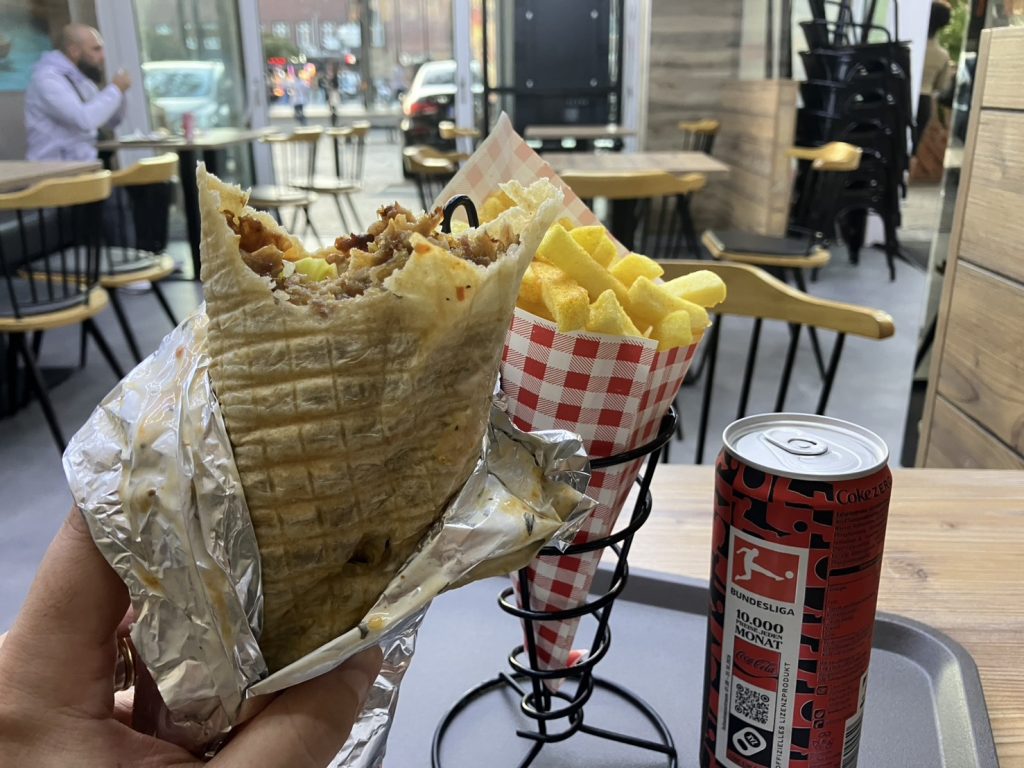
これを食べにドイツへ来たと言ってもいい。
私のなかでは、世界一うまい食べ物の一つである。
ドイツに留学していた頃には500円くらいで食べられた記憶がある。それが今では1000円くらいする。
ずいぶん高くなった。
それでも、まだコスパがいいと感じる。
野菜はもちろん全部入れてもらう。チーズも追加する。ソースは基本的にTzatziki。水切りヨーグルトにキュウリやニンニクなどを混ぜたソースである。それにKnoblauch(ニンニクソース)、さらに少し唐辛子を加える。
優勝である。
港町Emdenでは、カニのスープと魚介のブイヤベースも食べた。
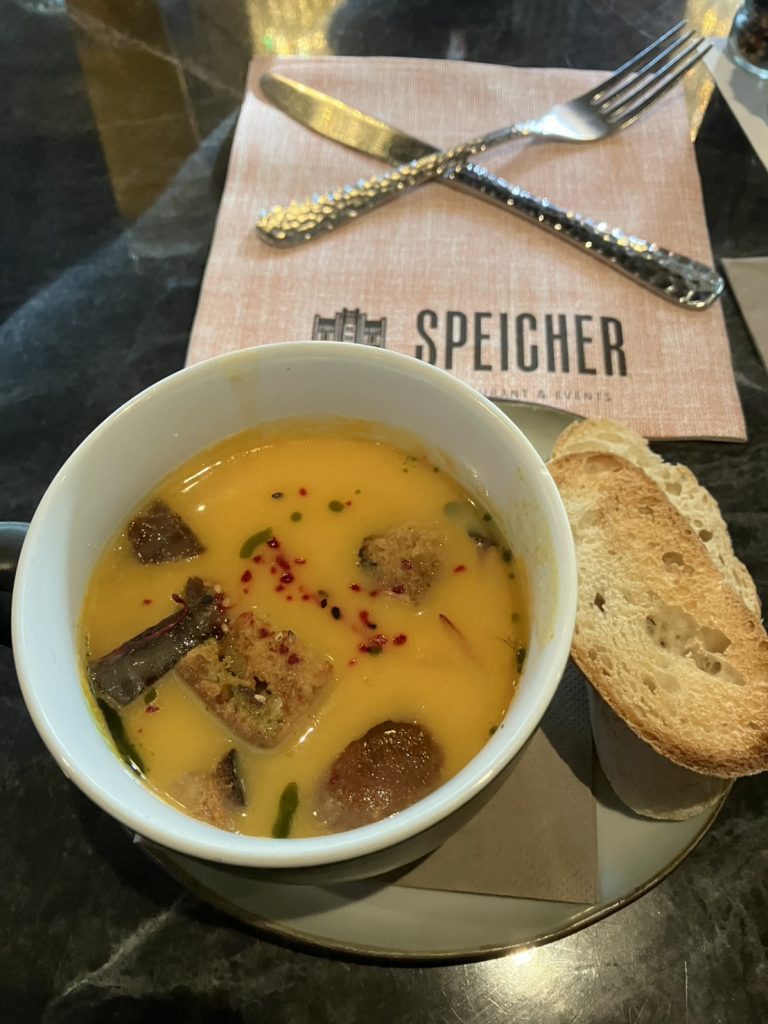
普段の英国生活では、食事についてここまで文章が饒舌になることはあまりない。
英国に失礼なので、理由については深く考えないことにする。
念のため書いておくと、英国にもうまいものはたくさんある。そのうち、この滞在記でも紹介したい。
今回のドイツ滞在は、もちろん食べ歩きの旅ではない。
9月29日に英国を出て、10月6日までの8日間。Berlin、Emden、Oberhausen、Frankfurtを移動する研究出張である。大学に提出した出張計画にも、Berlinでの国際会議への参加、Emdenでの学校教員とのフィールドリサーチ、Oberhausenのドイツ国際平和村との国際共同研究という三つの目的を書いた。
最初の目的地はBerlinだった。
2013年の夏に1か月ほど留学した、懐かしい場所である。
10月1日、2日の二日間、Humboldt-Universität zu BerlinでISCAR 2026 Central Europe Regional Conferenceが開催された。今回のテーマは、”Development, Acceleration and Alienation”。
発達、加速、疎外。
文化・歴史的活動理論の研究者たちが、「時間」と「人と人との関係」を一つの軸に集まる会議だった。 出張信憑書類01-4_ISCAR2026Berlin_Book…
文化・歴史的活動理論は、私が現在取り組んでいるChange Laboratoryの理論的基盤でもある。
Change Laboratoryは、研究者が現場へ行って、「あなたたちの問題はこれです」「こう変わってください」と答えを与える方法ではない。
実践に携わる人たちと研究者、それにさまざまなステイクホルダーが、いま生じている問題を一緒に検討する。その過程で、そもそも何が問題なのかを問い直し、それがどのような歴史のなかで生まれてきたのかをたどりながら、これからの新しい活動のあり方を考えていく。
英国へ来てからは、Lancaster Universityの先生と、これをオンラインで実施する際の利点や問題点を洗い出し、論文の共同執筆を進めている。
今回のISCARでは、Change Laboratoryをめぐる国際共同研究の可能性について、短いpitchを行った。
タイトルは、
Connecting Change Laboratory Communities Across Regions: What Can We Learn from Each Other?
地域を越えてChange Laboratoryのコミュニティをどうつなぎ、互いの経験から何を学ぶことができるのか。
日本を含む東アジアでも、文化・歴史的活動理論やChange Laboratoryへの関心は少しずつ広がっている。一方、私自身はいま英国で、オンラインで行うChange Laboratoryの可能性を考えている。
だったら、それぞれの場所で個別に研究するだけでなく、世界のさまざまな地域で実践している人たちの経験をつなぐことはできないだろうか。
もちろん、教育は地域や文化に根ざした固有の営みである。ある場所でうまくいったものを、別の場所へそのまま「輸入」すればよいわけではない。むしろ弊害を生むこともある。
それでも、互いに学ぶことはできるのではないか。
そんな問いを会場へ投げた。
短い発表だった。
けれど、短いからこそ、「私はいま、これを考えています。興味があったら話しましょう」と差し出すことができる。
前にこの滞在記で、「途中」の研究を人に差し出すことについて書いた。
今回も、完成した研究成果を披露しに行ったというより、まだ形になっていない問いを持って、人に会いに行ったという方が近い。
そして、実際に多くの人が話しかけてくれた。
カンファレンスディナーが終わったあとには、「もう一軒行こう」とバーにも誘ってもらった。
こういうとき、以前の私ならどうしていただろう。
英語でちゃんと話せるだろうか。
知らない人ばかりだったらどうしよう。
明日もあるし、ホテルへ帰った方がいいのではないか。
たぶん、いろいろ考えていたと思う。
今回は行った。
そして、楽しかった。
自分で言うのも少し憚られるのだが、最近、私は友達を作るのが上手くなったような気がする。人種や言語の違いも、以前ほど大きな壁には感じなくなった。
英語が格段に上手くなったわけではない。
ドイツ語に至っては、10年前より上手くなっているはずもない。
それでも、分からなければ聞けばいいし、言えなければ別の言い方をすればいい。
No.7で、英国へ来てから「言語ができない」ということを、以前ほど重大な問題だと思わなくなったと書いた。
もしかすると、その続きなのかもしれない。
言葉が十分になってから人と関係をつくるのではない。
関係をつくろうとするから、足りない言葉を使うことになる。
Berlinでは、久しぶりに壁も見た。
East Side Galleryを訪れたのは初めてだった。
そこには、かつて東ドイツの指導者だったErich Honeckerと、ソ連のLeonid Brezhnevが抱擁し、口づけを交わす有名な絵が描かれている。
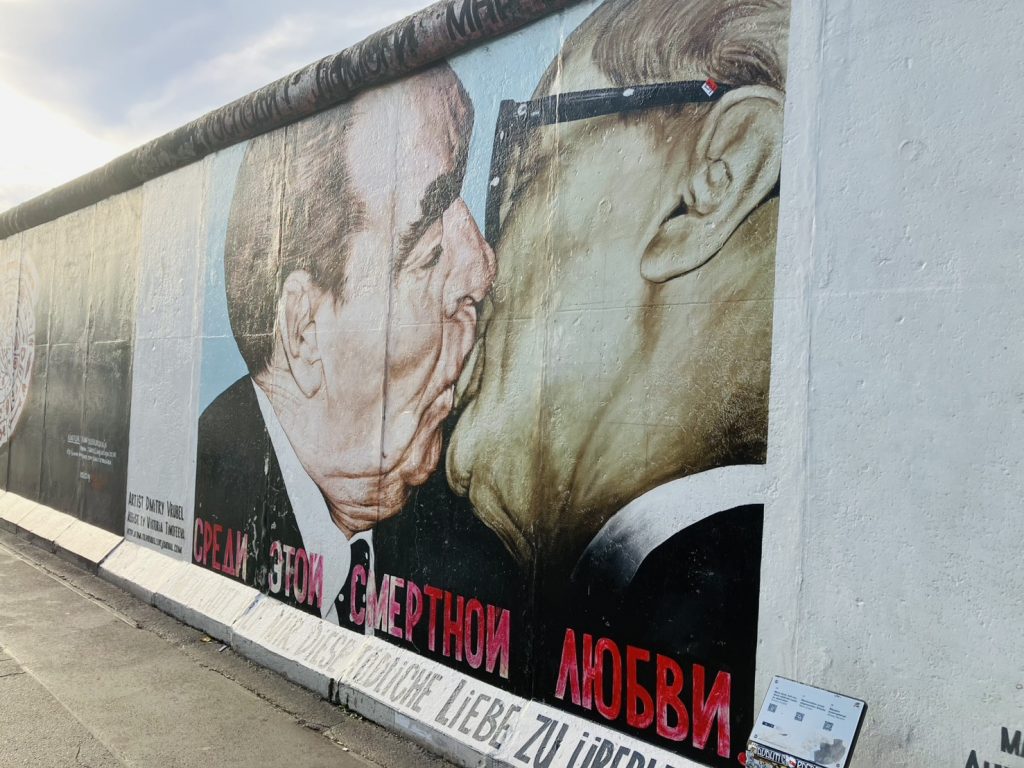
壁は、かつて人を分けるためにあった。
いまは世界中から来た人が、その壁の前で立ち止まり、写真を撮る。
分断のためにつくられたものが、後になって人を集める場所になる。
歴史というのは、ときどき妙な残り方をする。
Berlinを出て、次に向かったのはEmdenだった。
ここには、2016年のドイツ留学以来の友人がいる。
10年近く経てば、当然、彼らの生活も変わっている。
仕事を得る。
家族が増える。
子どもが大きくなる。
こちらも大学院生ではなくなり、大学教員になり、二人の子どもの父親になった。
それでも、会えば案外すぐに昔の距離へ戻れる。
今回は、小学校や職業教育に携わる友人たちから、現在の学校現場について話を聞いた。
私はいま、Change Laboratoryをはじめとする形成的介入研究に関心を持っている。
異なる専門性や立場を持つ学校の先生たちが、どうすれば一緒に自分たちの仕事を捉え直し、新しい実践をつくることができるのか。
論文を読んでいるだけでは見えないものが、友人との会話のなかでは急に具体的になる。
制度の話をしていたはずが、いつの間にか同僚との関係の話になる。
教育について話していたはずが、家族や病院、年金制度の話になる。
研究について話していたはずが、猫の話になる。
そしてミーティングの後には、ご家族が所有するカナルボードにも乗せてもらった。
運河を進みながら話していると、「フィールドリサーチ」という言葉が少し大袈裟に感じられてきた。
ISCARで、「この後、Emdenに行くんだ」と話したときのことである。
「何をしに行くの?」
と尋ねられた。
最初は「フィールドリサーチ」と答えた。
相手は、いまひとつ腑に落ちない顔をした。
そこで、
「友人がいるんだ」
と言った。
すると、「その言い方の方がずっといい」と言われた。
考えてみれば、きっとその方が「活動理論的」なのだと思う。
関係が先になければ、形成的介入研究は、研究者が外から現場を変えようとするトップダウンの営みになりかねない。
あるいは、研究者があらかじめ描いたデザインに現場を適応させていく、リニアなものになってしまう。
少し乱暴に言えば、営業と同じなのかもしれない。
こちらから「この方法を使いませんか」と売り込むのではない。
むしろ、相手の方から、いつかこんなふうに言ってもらえる関係をつくる。
「なお、実は○○で今困ってるんだ。君の力で、なんとかならないだろうか」
そこから初めて、一緒に考える仕事が始まる。
研究というものは、本来、こういう時間から生まれるのかもしれない。
相手の生活の場所へ行く。
同じものを食べる。
一緒に移動する。
どうでもいい話をする。
そして、その人が何を大切にしているのかを、少しずつ知る。
今回の旅では、ドイツの退職された名誉教授との新しい出会いもあった。
話しているうちに、12月にはFrankfurtへ来ないかと声をかけていただいた。
今度は家族で訪ねようと思っている。
この出会いについて言えば、2016年の留学経験と、広島大学で学んだドイツ教授学が、思いがけないところでつながった。
先生の発表を聞きながら、私は何度もKlafkiを思い出していた。
一方で、今回、Osnabrückには行かなかった。
留学時代に大変お世話になった先生にも連絡をしなかった。
旅程の問題もある。
けれど、それだけではなかったと思う。
Mollenhauerやオスナブリュックの先生に関わる研究を、このところ十分に進められていない。そのことへの、少しの後ろめたさがあった。
宿題は、まだたくさんある。
それでも、一つの出張が終わる前に、もう次に会う約束ができる。
こういうことが、最近とても嬉しい。
そして10月5日、OberhausenにあるFriedensdorf International、ドイツ国際平和村を訪れた。
私がここを最初に訪れたのは、2016年1月である。
それから何度か訪れ、大学の学生を連れてきたこともあった。
これまで私は、ここへ来るたびに、平和村の活動について教えてもらう側だった。
平和とは、単に戦争がないことなのか。
人間の基本的な権利が奪われている状態を、平和と呼べるのか。
そして、その権利のなかに「学ぶこと」はどう位置づくのか。
教育研究者として、ここで考えさせられたことは多い。
だから今回は、少しだけ違うことをしてみたかった。
これまで受け取ってきた場所へ、自分の研究から何かを持って帰りたかった。
ただし、答えではない。
問いを持っていった。
今回の話題提供につけたタイトルは、
How Can We Help Without Deciding Who Another Person Should Become?
「相手がどのような人になるべきかを、こちらが決めることなく、どうすれば人を助けることができるのか」。
そんな問いである。実際の発表でも、私は「答え」ではなく、自分の研究から生まれてきた「問い」を平和村へ持ち込みたい、と最初に話した。
教育は、人を変えようとする営みである。
教師は、子どもに何かができるようになってほしいと思う。
研究者も、教育実践がよりよいものになってほしいと思って介入する。
援助する人も、目の前の誰かの状況がよくなってほしいと思う。
それ自体が悪いわけではない。
しかし、そこで避けられない問いがある。
「よりよい」とは、誰が決めるのか。
私は、戦時下の中国で教育について講演した長田新、子どもの自己表現を重視しながら植民地の日本語教育にも関わった芦田恵之助、そして自分自身が幼い頃に書いた作文を材料に、この問題を考えてきた。
そして最後には、自分自身が現在行っているChange Laboratoryへ話を戻した。
私は、歴史上の教育者を安全な場所から批判するだけではいられない。
私自身もまた、教育現場に「介入」する研究者だからである。
Change Laboratoryでは、研究者が完成した答えを現場へ持ち込むのではなく、参加者が自分たちの活動を分析し、新しい可能性をつくることを支援しようとする。
けれど、「一緒に変える」と言えば問題が解決するわけでもない。
誰が問題を定義するのか。
誰が「よくなった」と判断するのか。
そして何より、誰が「嫌だ」と言えるのか。
「参加型」と名づけても権力は消えない。
「協働」と呼んでも影響力はなくならない。
だから私は最後に、答えを示す代わりに、平和村で働く方々へ尋ねた。
人を助けようとするとき、自分がその人に望むことと、その人自身が望むことが違ったら、どうするのか。
誰かを助けることによって、むしろ自分自身の「助ける」という考え方が変わった経験はあるか。
そこから始まった対話が、とても面白かった。
参加してくださった方々の食いつきが驚くほどよかった。
質問が返ってくる。
具体的な経験が語られる。
こちらもまた問い返す。
英語で話す。
ときどきドイツ語を使う。
もちろん、どちらも十分ではない。
それでも、昨日は、少し大袈裟に言えば、魂でやり取りができたような気がした。
研究者として、これはかなり嬉しいことである。
論文が引用されることも嬉しい。
学会で評価されることも嬉しい。
けれど、自分が何年も考えてきた問いを差し出したとき、目の前の人の経験が動き出し、「それなら私はこう思う」と返ってくる。
研究が自分の手を離れ、相手の経験のなかで別のものになって返ってくる。
その瞬間には、また別の喜びがある。これが本物のゼミナールだ。昨年度の学部ゼミでも、一度だけそんな瞬間があった。まるで本当に火花が見えるように、若者が燃え上がるのである。
そして、Emdenで考えたことが、ここでもう一度戻ってきた。
「なお、実は○○で今困ってるんだ。君の力で、なんとかならないだろうか」「先生、私困っているんです…。なんとかならないでしょうか…」
私は一人の小さな人間である。
私一人にできることなど、たいして多くない。
話を聞く。
その場に一緒にいる。
そして、ときどき、自分が考えてきたことを話す。
それくらいである。
それでも、自分がこれまでやってきた教育学で、困っている人に何か希望を抱いてもらうことはできないだろうか。困っている人に、教育学で応えたい。
そう考えると、TRIADEでは、すでにずいぶん幸せな思いをさせてもらっている。
「TRIADEがあったから、出版という夢が叶いました」
「心が震えました」
「研究者の未来も、暗い話ばかりじゃないですね」
実際にいただいた、私にとって宝物のような言葉である。
困っている人に、TRIADEという仕事を通して応えられることがある。
これは、何よりも幸せなことである。
平和村を初めて訪れた2016年以来、私のなかには、もう一つの問いが残り続けている。
ここで出会う子どもたちの多くは、それぞれの国では十分な治療を受けることが難しく、ドイツへやって来ている。骨髄炎で骨が溶け歩けなくなった子供、地雷で腕や足を失った子供、劣化ウラン弾のようなもので、どこに目や鼻があるのか一見してわからないような子供たち。
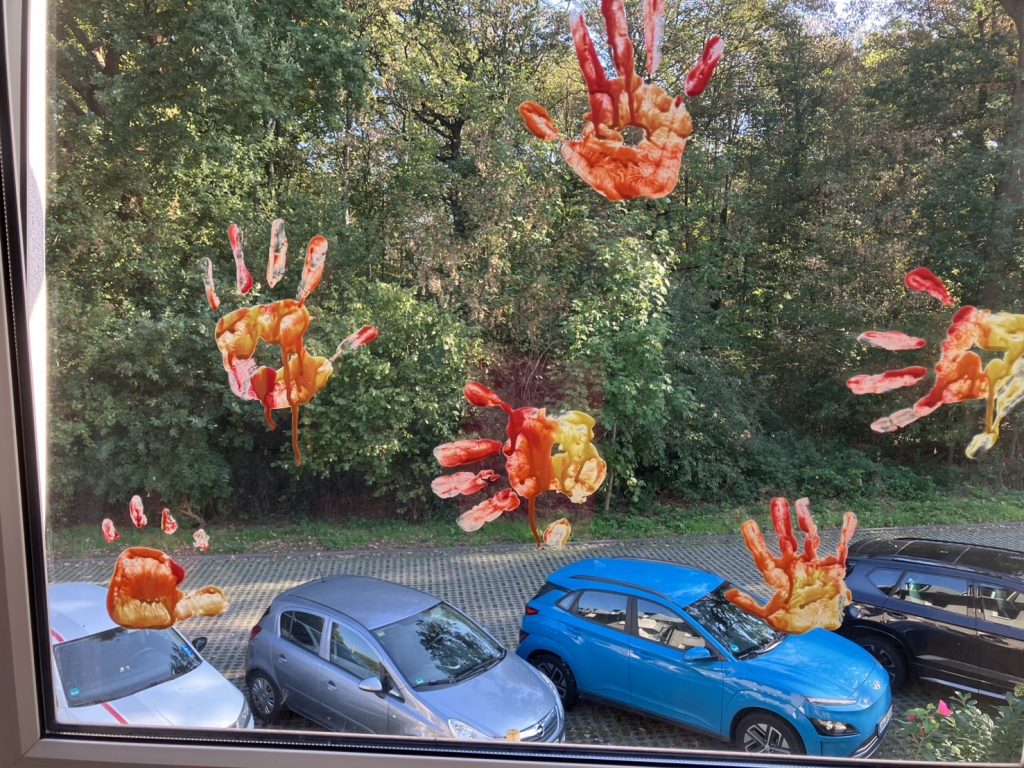
※「秋」をテーマにそれぞれの手形で彩った窓。左下の手形には指先がない、このブログではあえて子供たちの傷にフォーカスを当てているが、本来平和村では、こんな描写をする必要すらない。「完全な人間」なんてどこにも居ないのだから。
さまざまな困難を抱えている彼らだが、実際に会う子どもたちは、こちらが驚くほど好奇心旺盛でエネルギッシュだ。昨日もたくさん声をかけてもらった。
私は、この子どもたちに何ができるのだろう。
2016年以来、その問いに対して、私は授業で平和村について学生たちに紹介することで、どこか自分に言い訳をしてきたところがある。
もちろん、それにも意味はあると思う。
けれど、それだけでよいのだろうかという問いも、ずっと残っていた。
継続は力なり、ということなのかもしれない。
今回は、平和村の教育部の方々とも、これまでよりずっと深い話ができた。
「教育と平和」という問題が、ようやく私自身の研究の俎上に上がり始めたような気がしている。
今回のドイツ出張を振り返ると、ずいぶんいろいろなことをした。
Berlinで学会に参加した。
pitchをした。
研究者たちと議論した。
Emdenで学校教育について話を聞いた。
船に乗った。
Oberhausenで話題提供をした。
そして、その合間にPommesを食べ、Dönerを食べ、カニのスープを食べた。
こうして書くと、やはり食べている。
でも、この一週間を思い出したとき、食べ物と研究がそれほど別々のものには思えない。
誰かと食べる。
誰かと歩く。
誰かと話す。
研究の話をする。
どうでもいい話もする。
また会おうと言う。
研究という仕事のかなり大きな部分は、結局のところ、そうやって人とのあいだに何かをつくることなのかもしれない。
以前の私は、海外の学会へ行くと、「何を発表するか」を何より気にしていた。
もちろん、いまも発表は大事である。
準備もする。
質問されれば緊張もする。
けれど最近は、「何を持って帰るか」が少し変わってきた。
知識だけではない。
次に話したい人ができる。
また訪ねたい場所ができる。
「今度はこちらへ来てください」と言える人が増える。
そして、いつか何かに困ったとき、「ちょっと一緒に考えてくれないか」と言い合える人が増える。
今回の旅でも、そういう人が増えた。
考えてみれば、No.9で、子どもたちが家から出ていくことについて書いた。
人は誰かから離れることで、一人になるのではない。
別の誰かとの関係へ入っていく。
そんなことを書いた直後に、今度は私自身がLancasterの家を出て、ドイツを一週間動き回っていた。
Berlinへ行った。
Emdenへ行った。
Oberhausenへ行った。
Frankfurtへ行った。
そして、それぞれの場所で人に会った。
40歳を前にして、ようやく私は、知らない場所へ行くことが以前より少し上手になったのかもしれない。
いや、場所へ行くことではない。
人のところへ行くことが、少し上手になった。
明日はドイツを離れ、英国へ戻る。
帰れば、また子どもたちの学校がある。
Lancaster Universityでの共同研究もある。
月末にはGlasgowで講演があり、その翌日にはCambridgeへ向かう。
12月には、またドイツへ来ることになるかもしれない。
予定表には、また場所の名前が増えていく。
けれど、最近、その名前の見え方が少し変わった。
Berlin。
Emden。
Oberhausen。
Frankfurt。
それはもう、地図の上にある点だけではない。
そこには、顔がある。
話したことがある。
一緒に食べたものがある。
また会いたい人がいる。
そうやって世界は、少しずつ近くなるのかもしれない。
さて。
最終日の夜は、名物のEisbeinとApfelweinをいただいた。
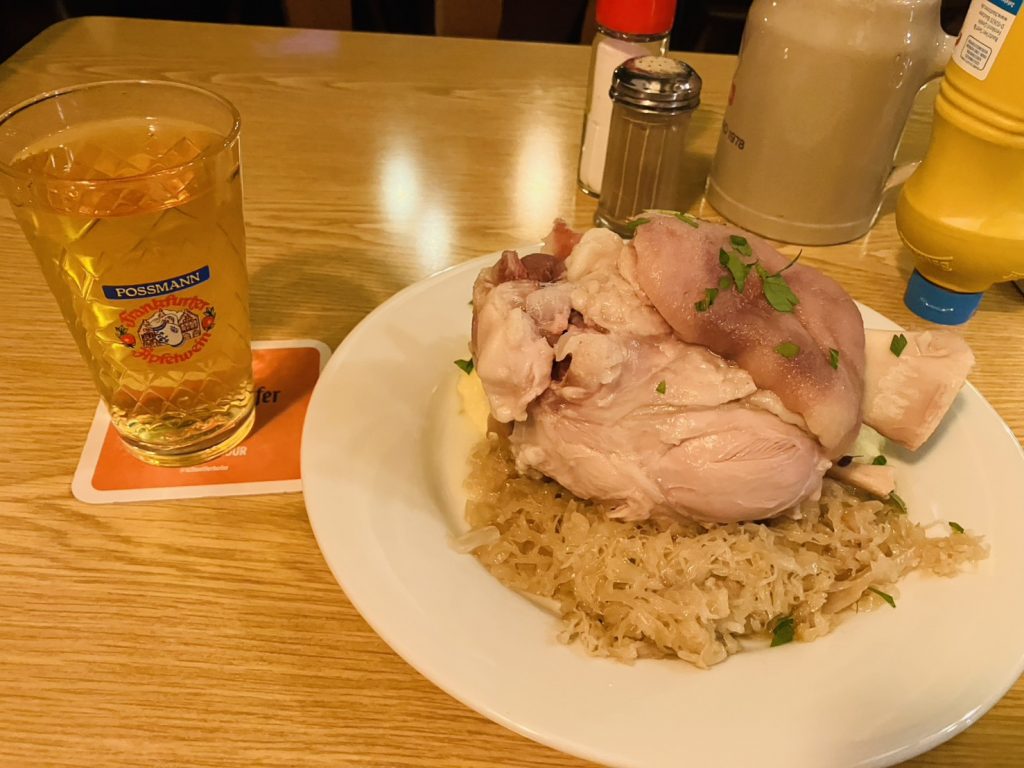
英国へ帰る前に、もう一度Dönerを食べておこうと思う。
Notes from My Stay in the UK, No. 10
Germany, Germany, Germany! — Research as Going to Meet People
Germany, Germany, Germany!
I have lost count of how many times I found myself shouting “Deutschland!” in my head during this trip.
Germany is great.
Above all, the food is good.
The weather is good.
That, admittedly, was just luck.
The people are good, too.
That also needs to be taken with a considerable grain of salt, since many of the people I met this time were people I already liked very much.
Things are cheap.
Or at least they feel cheap when you come from the UK.
There are, in other words, plenty of qualifications to be made.
And yet, throughout my time in Germany, I found myself strangely exhilarated.
Of course, there was nostalgia. I studied in Germany in both 2013 and 2016.
The smell when you enter a railway station. The announcements on the trains. The things lined up on supermarket shelves. The way people dress as they walk through the city. The sound of German in my ears again after so long.
But apparently it was more than nostalgia.
Visiting Germany for a short time from the UK was simply enormous fun.
First of all, the Pommes are delicious.
Just look at them.
A generous portion of Pommes, covered in sauce, costs about three euros.
I am actually quite fond of freshly fried McDonald’s fries with extra salt, but these are about five times better.
There is no scientific basis whatsoever for that figure.
And then there is Döner.
I could almost say that I came to Germany just to eat this.
For me, it is one of the best foods in the world.
When I was studying in Germany, I remember being able to buy one for around 500 yen. Now it costs closer to 1,000 yen.
It has become considerably more expensive.
And yet it still feels like excellent value.
I have all the vegetables, of course. I add cheese. For the sauce, my basic choice is Tzatziki, made with strained yoghurt, cucumber, garlic and other ingredients. Then Knoblauch—garlic sauce—and a little chilli.
Unbeatable.
In the port city of Emden, I also had crab soup and a seafood bouillabaisse.
I do not usually become quite this eloquent about food in my accounts of life in Britain.
Out of respect for the UK, I will refrain from examining the reasons too closely.
Just for the record, there is plenty of good food in Britain as well. I hope to introduce some of it in this series eventually.
Of course, this trip to Germany was not a food tour.
I left the UK on 29 September and travelled through Berlin, Emden, Oberhausen and Frankfurt over eight days, returning on 6 October. In the official travel plan I submitted to my university, I listed three purposes: attending an international conference in Berlin, conducting field research with schoolteachers in Emden, and pursuing international collaborative research with Friedensdorf International in Oberhausen.
My first destination was Berlin.
It was a nostalgic place for me. I had spent about a month there in the summer of 2013.
On 1 and 2 October, the ISCAR 2026 Central Europe Regional Conference was held at Humboldt-Universität zu Berlin. Its theme was “Development, Acceleration and Alienation.”
Development. Acceleration. Alienation.
It brought together researchers in cultural-historical activity theory around questions of time and human relationships.
Cultural-historical activity theory also provides the theoretical foundation for the Change Laboratory, which is one of the main approaches I am currently working with.
A Change Laboratory is not a method in which researchers enter a field and announce:
“This is your problem.”
“This is how you need to change.”
Instead, practitioners, researchers and various stakeholders examine the problems they are facing together. In doing so, they reconsider what the problem actually is, trace how it emerged historically, and explore possible new forms of activity for the future.
Since coming to the UK, I have been working with a colleague at Lancaster University to identify both the possibilities and the problems involved in conducting Change Laboratories online, and we are now developing a paper together.
At ISCAR, I gave a short pitch about the possibility of international collaboration around Change Laboratory research.
The title was:
Connecting Change Laboratory Communities Across Regions: What Can We Learn from Each Other?
How might we connect Change Laboratory communities across regions, and what might we learn from one another’s experiences?
Interest in cultural-historical activity theory and the Change Laboratory has gradually been growing in East Asia, including Japan. At the same time, here in the UK I have been exploring the possibilities of conducting Change Laboratories online.
So rather than each of us working separately in our own locations, could we somehow connect the experiences of people already engaged in this work across different parts of the world?
Education, of course, is always rooted in particular regions and cultures. Something that works in one place cannot simply be “imported” wholesale into another. Doing so can sometimes cause more harm than good.
But perhaps we can still learn from one another.
That was the question I put to the room.
It was a short presentation.
But precisely because it was short, I could offer it simply as:
“This is what I am thinking about right now. If you are interested, let’s talk.”
Earlier in this series, I wrote about offering research to others while it is still “in progress.”
This time, too, it felt less as though I had gone there to present a completed piece of research than that I had gone to meet people while carrying a question that had not yet fully taken shape.
And people did indeed come and talk to me.
After the conference dinner, I was invited to go on to a bar for another drink.
I wonder what the old me would have done in that situation.
Would I be able to speak properly in English?
What if I did not know anyone?
There was another day of the conference tomorrow. Wouldn’t it be better just to go back to the hotel?
I probably would have thought about all sorts of things.
This time, I went.
And I had fun.
I hesitate slightly to say this about myself, but recently I have begun to feel that I have become better at making friends. Differences of language and background no longer feel like the barriers they once did.
It is not that my English has suddenly become dramatically better.
As for my German, there is no conceivable reason why it should be better than it was ten years ago.
But if I do not understand something, I can ask.
If I cannot say something one way, I can try another.
In No. 7 of this series, I wrote that since coming to Britain, I have stopped regarding “not being able to speak the language” as quite such a serious problem.
Perhaps this is a continuation of that thought.
We do not wait until our language is good enough before forming relationships with people.
We try to form relationships, and that is why we end up using whatever imperfect language we have.
In Berlin, I also saw the Wall again.
It was my first visit to the East Side Gallery.
There, on the Wall, is the famous painting of Erich Honecker, the former leader of East Germany, and Leonid Brezhnev of the Soviet Union embracing and kissing.
The Wall was once there to divide people.
Now, people from all over the world stop in front of it and take photographs.
Something built for division later becomes a place where people gather.
History sometimes survives in peculiar ways.
From Berlin, I travelled next to Emden.
I have friends there whom I have known since my time studying in Germany in 2016.
Almost ten years have passed, so naturally their lives have changed.
They have jobs.
Their families have grown.
Their children have grown.
I, too, am no longer a graduate student. I have become a university lecturer and the father of two children.
And yet, when we meet, we somehow return quite quickly to the old sense of closeness.
This time, I spoke with friends working in primary and vocational education about what is currently happening in their schools.
One of my present research interests is formative intervention, including the Change Laboratory.
How can teachers with different forms of expertise and different positions come together to reconsider their own work and create new practices?
Things that remain invisible when I am simply reading academic papers suddenly become concrete in conversations with friends.
We begin by talking about educational systems, and before long we are talking about relationships with colleagues.
We begin by talking about education, and somehow end up discussing families, hospitals and pensions.
We begin by talking about research, and end up talking about cats.
After our meeting, they even took me out on a boat.
As we travelled along the waterways talking, the phrase “field research” began to sound slightly grandiose.
At ISCAR, I had told someone, “I’m going to Emden after this.”
“What are you going there for?” they asked.
At first, I answered, “Field research.”
They did not look entirely convinced.
So I added:
“I have friends there.”
“That sounds much better,” they said.
Thinking about it now, perhaps that is actually the more “activity-theoretical” way of putting it.
Without relationships coming first, formative intervention research can easily become a top-down enterprise in which researchers try to change practice from outside.
Or it can become a linear process in which the field is expected to adapt itself to a design already drawn up by the researcher.
To put it somewhat crudely, perhaps it is a little like sales.
The point is not to approach someone and say, “Would you like to use this method?”
It is to build a relationship in which, one day, the other person might say:
“Nao, actually, we’re having trouble with something. Do you think you could help us figure it out?”
Only then does the work of thinking together really begin.
Perhaps research, at its best, grows out of time like this.
You go to where another person lives and works.
You eat the same food.
You travel together.
You talk about things that do not matter very much.
And little by little, you begin to understand what matters to that person.
This trip also brought a new encounter with a retired German professor emeritus.
As we talked, he invited me to come to Frankfurt in December.
Next time, I hope to visit with my family.
In this encounter, my experience studying in Germany in 2016 and what I had learned about German Pädagogik at Hiroshima University connected in a way I had not expected.
As I listened to his presentation, I found myself thinking repeatedly of Klafki.
On the other hand, I did not go to Osnabrück this time.
Nor did I contact a professor there who had been extremely kind to me during my time studying in Germany.
There were practical reasons in the itinerary.
But I do not think that was the whole story.
Recently, I have not made enough progress with my research related to Mollenhauer and the work I encountered in Osnabrück. I think I felt slightly guilty about that.
There is still plenty of homework left to do.
Even so, before one research trip has ended, another promise to meet has already been made.
Recently, that has made me very happy.
Then, on 5 October, I visited Friedensdorf International in Oberhausen—the organisation known in Japan as the German International Peace Village.
I first visited in January 2016.
I have returned several times since then, and on one occasion brought university students with me.
Until now, whenever I came here, I was always the one learning from the work of Friedensdorf.
Is peace simply the absence of war?
Can we call a situation peaceful when people are deprived of their basic human rights?
And where does the right to learn belong among those rights?
As a researcher in education, this place has given me a great deal to think about.
So this time, I wanted to do something slightly different.
I wanted to bring something from my own research back to a place from which I had received so much.
Not an answer.
A question.
The title of my talk was:
How Can We Help Without Deciding Who Another Person Should Become?
That was the question.
At the beginning of the talk, I explained that I had not come to Friedensdorf with an “answer,” but with a “question” that had emerged from my own research.
Education is an activity that seeks, in some sense, to change people.
Teachers want children to become able to do things they could not do before.
Researchers intervene because they hope educational practice might become better.
People who provide support hope that the situation of the person before them will improve.
There is nothing inherently wrong with any of this.
But it leaves us with an unavoidable question.
Who decides what counts as “better”?
I have been thinking about this question through the work of Arata Osada, who lectured on education in wartime China; Einosuke Ashida, who valued children’s self-expression while also becoming involved in Japanese-language education under colonial rule; and compositions I myself wrote as a child.
Finally, I brought the discussion back to the Change Laboratory work I am doing now.
I cannot simply criticise educators of the past from the safety of the present.
I, too, am a researcher who “intervenes” in educational practice.
In a Change Laboratory, researchers do not bring ready-made answers into the field. Instead, they try to support participants in analysing their own activity and creating new possibilities for themselves.
But simply saying, “We will change things together,” does not make the problem disappear.
Who defines the problem?
Who decides that things have “improved”?
And, perhaps most importantly, who is able to say, “No”?
Calling something “participatory” does not make power disappear.
Calling it “collaborative” does not eliminate influence.
So rather than ending by giving an answer, I asked the people working at Friedensdorf two questions.
When you try to help someone, what do you do when what you want for that person differs from what they want for themselves?
And have you ever had the experience of helping someone change your own understanding of what it means to “help”?
The conversation that followed was fascinating.
The participants engaged with the questions far more intensely than I had expected.
Questions came back.
People told stories from their own experience.
I asked further questions in return.
We spoke in English.
Sometimes I used German.
Neither language, of course, was anywhere near perfect.
And yet, if I may put it a little dramatically, I felt that yesterday we somehow managed to communicate soul to soul.
For a researcher, that is an extraordinary pleasure.
It is gratifying when one’s papers are cited.
It is gratifying to have one’s work recognised at an academic conference.
But there is another kind of joy when you offer a question you have been thinking about for years, and something begins to move in the experiences of the people sitting in front of you.
They respond:
“If that is the question, then this is what I think.”
The research leaves your hands, becomes something different within another person’s experience, and then comes back to you.
There is a different kind of joy in that moment.
This is what a real Seminar is.
There was one moment like that in my undergraduate seminar last year as well. It was almost as though you could actually see the sparks: the young people in the room suddenly caught fire.
And then, what I had been thinking about in Emden returned to me once again.
“Nao, actually, we’re having trouble with something. Do you think you could help us?”
“Professor, I’m struggling with something… Is there anything we can do?”
I am only one small human being.
There is not very much I can do on my own.
I can listen.
I can stay there with someone.
And from time to time, I can talk about the things I have been thinking about.
That is about all.
And yet, could the educational research I have spent all these years doing give even a little hope to someone who is struggling?
I want to respond to people in difficulty through education.
When I think about it that way, TRIADE has already given me the privilege of experiencing a great deal of happiness.
“Because of TRIADE, my dream of publishing a book came true.”
“I was deeply moved.”
“Perhaps the future of researchers isn’t all doom and gloom after all!”
These are words people have actually said to me, and I treasure them.
Sometimes I can respond to someone who is struggling through the work we do at TRIADE.
There is little that makes me happier.
Ever since my first visit to Friedensdorf in 2016, another question has remained with me.
Many of the children I meet here have come to Germany because it is difficult for them to receive adequate medical treatment in their home countries.
Some have been unable to walk because osteomyelitis has severely damaged their bones. Some have lost arms or legs to landmines. Some have suffered devastating injuries in war, leaving their faces profoundly altered.
※The window was decorated for “autumn” with handprints made by the children. The handprint at the lower left is missing the tips of its fingers. In this blog post, I have deliberately drawn attention to the children’s injuries. At Friedensdorf itself, however, there is no real need to describe them in this way. After all, there is no such thing as a “complete” human being.
The children live with many different kinds of difficulty. Yet when you actually meet them, they are astonishingly curious and energetic.
Yesterday, too, many of them came over and spoke to me.
What can I do for these children?
That question has stayed with me since 2016.
For years, I think I partly justified myself by introducing Friedensdorf to my students in my university classes.
I still think there is meaning in doing that.
But another question has remained alongside it:
Is that enough?
Perhaps there really is something to be said for simply continuing.
This time, I was able to have much deeper conversations than before with members of Friedensdorf’s educational team.
I have begun to feel that the relationship between education and peace is finally becoming a subject of my own research.
Looking back over this research trip to Germany, I did a surprising number of things.
I attended a conference in Berlin.
I gave a pitch.
I discussed research with other scholars.
I talked with teachers about education in Emden.
I went out on a boat.
I gave a talk in Oberhausen.
And in between, I ate Pommes, Döner, and crab soup.
Writing it all down like this, I realise that I really did spend quite a lot of time eating.
But when I think back over the week, food and research do not seem entirely separate from one another.
You eat with someone.
You walk with someone.
You talk with someone.
You talk about research.
You talk about things that do not matter at all.
You say, “Let’s meet again.”
Perhaps a surprisingly large part of the work we call research consists, in the end, of creating something between people in just this way.
When I used to travel abroad for academic conferences, my main concern was always what I was going to present.
Of course, presentations still matter.
I prepare carefully.
I still get nervous when people ask questions.
But recently, what I think of as “bringing something home” has begun to change.
It is not only knowledge.
There are people I want to talk with again.
There are places I want to visit again.
There are more people to whom I can say, “Next time, please come and visit us.”
And there are more people with whom, when one of us runs into trouble someday, we might be able to say:
“Could we think about this together?”
This trip gave me more people like that.
Come to think of it, in No. 9 of this series, I wrote about my children leaving the house and going out into the world.
A person does not become alone simply by leaving someone behind.
They enter into relationships with someone else.
Immediately after writing that, I myself left our home in Lancaster and spent a week moving around Germany.
I went to Berlin.
I went to Emden.
I went to Oberhausen.
I went to Frankfurt.
And in each place, I met people.
As I approach forty, perhaps I have finally become a little better at going to places I do not know.
No.
That is not quite it.
I have become a little better at going to people.
Tomorrow, I will leave Germany and return to the UK.
When I get back, there will be the children’s school again.
There will be our collaborative research at Lancaster University.
At the end of the month, I will give a talk in Glasgow, and the following day I will travel to Cambridge.
In December, I may find myself back in Germany once again.
More and more place names are appearing in my calendar.
But recently, those names have begun to look slightly different.
Berlin.
Emden.
Oberhausen.
Frankfurt.
They are no longer simply points on a map.
There are faces there.
There are conversations we have had.
There are things we have eaten together.
There are people I want to see again.
Perhaps this is how the world gradually becomes a little closer.
Well then.
On my final evening, I had the local specialities Eisbein and Apfelwein.
Before I go back to Britain, I think I will have one more Döner.